I have served as a deacon for decades across two churches. Long before becoming a deacon, the church in which I grew up elected a friend and me to serve as “junior deacons” while we were high school teenagers—a non-voting position meant to expose us to the role and encourage our growth.
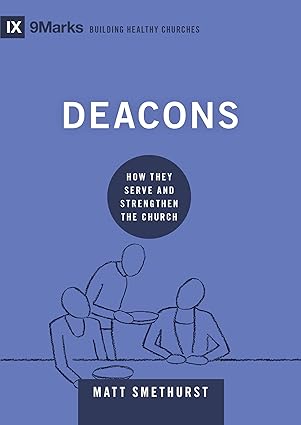
From that time as a junior deacon through years on church staffs and then decades as a layman, I have witnessed a variety of models regarding how deacons are organized and how they understand their roles. Some have been healthy and biblical, while others have left much to be desired. For that reason, and because I currently serve as the deacon chairman at my church, I was eager to read Matt Smethurst’s book Deacons: How They Serve and Strengthen the Church. Believing in the value of the book, I decided that our church should provide each of our 30+ Deacons with a copy and that we would go over its six excellent chapters during our six regularly scheduled meetings this year. The first meeting is behind us, and the book is being well-received.
As someone who has followed the author, Matt Smethurst, online for years, and who has been a huge fan of the publisher, 9Marks, I expected great content, and I wasn’t disappointed. The book is written in a conversational style and offers an informative and fascinating discussion of church history, along with various positive and negative models and examples of deacons. It will surely expand any deacon or church leader’s understanding of what the role should and should not be. A little humor along the way doesn’t hurt, either. What I appreciate most, however, is the solidly biblical foundation for its teaching.
As part of the 9Marks “Building Healthy Churches” series of books, Deacons breaks down the topic into six chapters, following a substantive “At Your Service” introduction:
- The Backstory and the Blunders: How Deacons Have Functioned
- The Blueprint: Where Deacons Began
- The Baselines: What Deacons Must Be
- The Breakdown: What Deacons Must Do
- The Benefits: What Deacons Provide
- The Beauty: Who Deacons Reflect
There is also a summary conclusion and two appendices, which provide a balanced discussion of whether women may serve as deacons and sample questions for deacon candidates. The small, 166-page book even provides a thorough index of topics and a Scripture index—additions which I always appreciate for future reference.
The author is soundly biblical in his understanding of the role of deacons, from considering the beginnings of the nature of deacon service from Acts 6 (chapter two) through the emphasis on biblical qualifications in 1 Timothy 3 (chapter three) to an understanding of how deacons are to serve (chapter four), all for the glory of Christ (chapter six). Through the ongoing biblical emphasis, the reader will likely recognize ways that his previous experiences or exposure to models of deacon service have either lived up to or strayed from what Scripture actually teaches. That may be a hard lesson for some, but it is a necessary one if we are to personally conform to the image of Christ and be obedient in his church to what his Word teaches.
There are a number of reasons why some churches may have strayed over time from a biblical model of deacons, but that does not excuse refusing to be open to returning to a healthy, biblical model. There is surely room for growth in individuals and churches regarding who are selected as deacons and the functions they perform. That is not to suggest that there is no room for variance among churches and denominations in the functions of deacons, but surely Scripture must be followed wherever it speaks, and we must not have practices that contradict Scripture’s clear teaching.
One of the helpful discussions that may result from a study of the book, especially if done in a group setting like the one I am taking our deacons through at my church, is Smethurst’s articulation of popular conceptions of deacons based on qualifications unrelated to Paul’s qualifications in 1 Timothy 3. He gives them names like Pastor-in-Training Peter, Toolbox Terrence, Spreadsheet Sam, Corporate Cliff, Veto Vinnie, and Pseudo-Elder Steve, each of whom is chosen as a deacon for a variety of skills that may be wonderful to have, but not necessarily qualifying in and of themselves for the role of deacon. It didn’t take me long to picture a few faces from my past when reading the book’s descriptions of some of those. Smethurst drills home repeatedly the biblical qualifications we should focus on, with other skills as “nice-to-haves.”
As the book’s subtitle suggests—”How They Serve and Strengthen the Church”—it rightly focuses on deacons as servants, not a “board” running the church or usurping the separate biblical role of elder. In explaining how deacons serve, Smethurst highlights three ways deacons can serve in the church: spotting and meeting tangible needs, protecting and promoting church unity, and serving and supporting the ministry of the elders. He categorizes possible healthy models for today as mercy ministers, a team of leading servants, and role-specific ministry mobilizers.
For practical examples of helpful deacon service, chapter five presents a series of brief, actual accounts of deacons serving and strengthening their church’s ministries. Such stories may spark ideas in the reader that help them break out of limited experiences and models, moving on to substantial and meaningful service for Christ in His church.
The role of a deacon is important to the church. It was conceived by God, taught in His Word, used throughout the history of the church, and should be valued by believers for the important function it provides in meeting the real needs of ministry. To organize deacons well and to set them apart for their task requires a sound biblical understanding of who such people are, individually, in terms of their character and faith, and what is expected of them as they serve and strengthen the church. A thoughtful reading and pondering of Deacons: How They Serve and Strengthen the Church can help a church and its leaders accomplish that task for the glory of God and the growth of His Kingdom. For that reason, I highly recommend it.
If you’d like to watch an hour-long interview of Matt Smthurst by Jonathan Leeman about the book, you’ll find it here:
