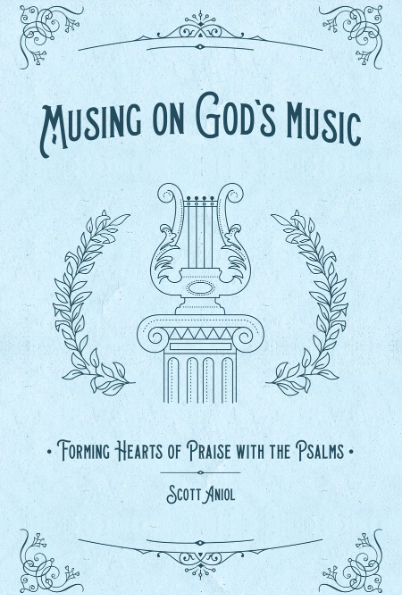
I’m currently leading my adult Bible study class at church through a years-long walk through Psalms. I’m reading a number of resources along the way, but the first that I read in full was Scott Aniol’s Musing on God’s Music: Forming Hearts of Praise with the Psalms. I first read it casually while on vacation with my wife, and then I read it a second time shortly before beginning our Psalms study in the summer of 2025. I was so impressed by the book’s focus and what I learned from it that it changed my approach to the study.
The author, Scott Aniol, has written several books, is the Executive Vice President and Editor-in-Chief of G3 Ministries, and Professor of Pastoral Studies at Grace Bible Theological Seminary.
Why was this book significant for me in changing my approach to teaching Psalms? It helped me better understand the significance of the organization of the Psalms and led me to a clearer focus when exploring them. The book of Psalms is not an unorganized collection of individual Psalms with no connection to each other. While it is true that the Psalms were written by multiple people over several generations, there is still order and meaning to the collection as we have them in Scripture.
In Joel Beeke’s back cover comments about the book, he writes: “In Musing on God’s Music, Scott Aniol explores two central ideas that can help Christians recover the importance of psalm singing today: the deliberate canonical organization of the Psalter and the purpose and power of poetry. Aniol provides an important corrective that will remedy modern deficiency among contemporary psalm usage by explaining that God has given us the Psalms, not merely to find a mood that fits our present state of being, but rather, God has given us the Psalms to form us.” That is the heart of Aniol’s message, and it is one I believe many need to hear as they read, pray, and experience Psalms.
Consider how many people tend to approach Psalms. With 150 psalms in Scripture, it is easy to fall into the habit of flipping through them or returning to one’s favorite psalms without ever stepping back and looking at the bigger picture of why they are organized as they are, much less how best to experience all of them. Perhaps you’ve seen lists that point you to particular psalms and other Bible passages when you feel a certain way (worried, sad, mourning, happy, etc.). Such lists are understandable, but Aniol’s point is that the psalms exist to shape our hearts and not merely to affirm the emotional state we currently experience. As we dive into God’s music in Psalms, He will shape us more into who we are supposed to be. Isn’t that infinitely better than searching out random texts that affirm us in our current state, whatever that happens to be at the moment?
Prior to reading Aniol’s book, I planned to lead my class through our Psalms study the same way you have perhaps studied it with a group, that is, by the major categories of psalms. Depending on the source, you’ll find a host of ways of categorizing them. A quick online search will yield many such breakdowns, ranging from as few as six to as many as fifteen types of psalms. There is no single commonly accepted categorization, in part because many of the psalms can rightly be placed into multiple categories, such as praise, thanksgiving, lament, or more. Such descriptors are useful, but they are not what the inspired writers themselves considered most important. Why, then, would we organize them differently in our study than how God chose to organize them in His Word?
Musing on God’s Music is written with three major sections following the initial chapter, which discusses why psalms are not sung as often today as in generations and centuries past. The three sections include “Foundations of Praise,” “A Five-Movement Cantata,” and “Ascending the Hill to Praise.” The “Foundations of Praise” section focuses on the significance of Psalms 1 and 2 for understanding the entire book. I can’t believe that in my 69 years of life and more than half a century of being a Christian, I’ve never been taught that before. The section “A Five-Movement Cantata” explains the organization of the remainder of Psalms into five books and why they should be read and understood in the order in which they appear in Scripture. The final section, “Ascending the Hill to Praise,” is particularly insightful in explaining the connection of psalms with how we worship God, forming hearts of repentance, trust, thanks, and praise. I appreciate the author’s classification of all the psalms in this last section of the book according to gospel function: revelation, adoration, confession and propitiation, thanksgiving, instruction, dedication, and supplication. That breakdown should make it easy for worship leaders to select relevant psalms for certain parts of worship.
Because of reading this book, I devoted a couple of months in my class to an introduction to Psalms, giving much of that time to Psalms 1 and 2. Then, rather than approach the remainder of Psalms by category, we are strolling through them sequentially. We sometimes pause to pray through a Psalm. Nearly every week we listen to or sing a Psalm, using a variety of available sources from YouTube and elsewhere. While reading them, we take time to meditate on their meaning and application. In short, the goal for my class for this study is to experience the Psalms, not just study them. I want our hearts to be formed by them, and for us to fall more in love with Christ and His Word because of this time in God’s songbook.
Whether you want a better understanding of Psalms for yourself or in preparation to teach, preach, or lead worship, I highly recommend Scott Aniol’s Musing on God’s Music. It isn’t and doesn’t attempt to be a commentary on all the Psalms, but it accomplishes well the purpose of helping the reader understand the big picture of Psalms, its organization, and purpose. There is great value in that. If you’re like me, it will forever change your understanding of the book of Psalms and its place in your life.
