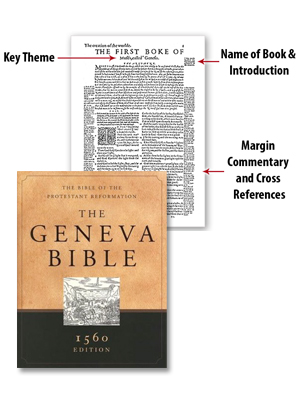
I love old books – both those printed editions that have survived centuries and are a joy to hold in your hands, and reprints of books originally published long ago. I am also a great fan of study Bibles, as the top of my rolltop desk would heartily testify if it could speak. It was, therefore, a no-brainer that I would be intrigued with the first study Bible ever published – The Geneva Bible. Once I learned of its existence a couple of years ago, I knew I had to get a copy and read it. I have just completed a joyful and enlightening 13-month experience of reading the 1560 edition, published by Hendrickson Publishers. This volume of more than 1,200 pages is a facsimile of the original.
First, let’s briefly summarize the historical context out of which this gem arose.
The dark days of Queen Mary’s reign in England in the 1550s saw horrific persecution of Protestants. She rightly earned the nickname “Bloody Mary.” Of course, others persecuted Protestants during that century and before, but her reign saw the peak of evil against believers in generations. Some fled England for safety, including those who went to Geneva and ultimately produced The Geneva Bible. It is the first English Bible translated directly from the Hebrew and Greek texts. It is the edition that came aboard the Mayflower to the New World. It is what John Bunyan would have had available to him when writing The Pilgrim’s Progress. Its frontispiece was the inspiration for Benjamin Franklin’s design of the first Great Seal of the United States. Some of its notes were included in editions of the King James Bible into the 1700s. It deserves to be known, read, and appreciated for its historical significance.
Next, let’s consider several features of this edition that qualify it as a legitimate study Bible:
- Introductory summaries of each book, called arguments;
- Running commentary in both margins of every page, clearly identified to explain a specific portion of text;
- A generous quantity of cross-references in the marginal notes;
- Illustrations and maps;
- Tables at the back of the Bible, including:
- an alphabetical list of proper names with a brief description and the first location reference,
- a concordance of names and topics with their first location reference,
- a fascinating table of years between the creation of Adam and the year 1560,
- and a table comparing the years from Christ’s incarnation with Paul’s conversion and ministry, and the corresponding reign of Roman emperors.
Additionally, this volume includes an extensive introduction to the facsimile edition, which addresses most historical questions, as well as a bibliography. The 1560 facsimile begins with the names and order of the biblical books, followed by a letter to Queen Elizabeth and another to Christians in England, Scotland, Ireland, and elsewhere. The Apocrypha is situated between the Old and New Testaments, although the introduction to it makes it clear that these books were not considered to be on the same level of inspired Scripture as the 66 canonical books; however, they are included as valuable for a historical perspective. There are a few cross-references and comments in the margins of the Apocrypha, but very few compared to the other books.
Regarding my experience reading through The Geneva Bible, I have much to share.
Since the text was published in 1560, the modern reader can expect to encounter occasional unfamiliar words and phrases. This is not insurmountable when the terms are found in the biblical text, as one can easily compare them with modern translations. It is more challenging when the terms are in the marginal notes. There is no modern equivalent to compare the commentary with, so the reader must either search online for the 1560 context of unfamiliar terms or eventually gain a sense of the meaning from the contexts in which they are found. Fortunately, this does not happen often enough to be a distraction or to make readers feel like they are missing out on anything substantial.
The physical act of reading the text, especially the marginal comments, can be challenging due to the very small print size and the fact that it is a facsimile of the original and not printed using a modern typeface. Because of this, I also kept a PDF of The Geneva Bible handy, which I could zoom in on as needed to read words that were too fuzzy or had characters missing in the printed edition. Due to the slow start in becoming familiar with the print, I initially attempted to read only a couple of chapters a day. After I became more accustomed to it, I settled into about three per day, with occasional spurts of up to five daily, which is how the 13-month completion timeframe came about. I chose not to read through the Apocrypha, as I do not consider it inspired Scripture, and I was already familiar with it, having studied it thoroughly years ago.
The joy of reading this edition, and one of my primary motivations, was to read the commentary by my Reformed ancestors in the faith from nearly 500 years ago, and it did not disappoint. The theology reflected a biblical understanding of Scripture consistent with Protestant Reformation leaders. Some comments reflected an understanding of specific passages that differed from what I have previously heard or believed, and I welcome that. We should expect some explanations and interpretations of secondary or tertiary matters to shift over time and across different cultural contexts. However, it is essential to note that core matters of the faith were taught the same then, just as they are currently. We should not expect fundamental Christian doctrine to change when God’s Word and God Himself do not.
If the reader is staunchly Protestant, as I am, he will probably smile while reading some of the commentary, particularly when the writers interpret passages in light of the Roman Catholic persecution of Protestants and the stark differences in substantial matters of faith and practice between the two. Do not be surprised when the commentary refers to the Pope, papists, priests, and others related to Roman Catholicism in very derogatory terms. And if you think the accusations are pointed in the first 65 books of the Bible, just wait until you read the commentary for Revelation! They hold nothing back. There were times when I had to take the Bible from my home office and find my wife elsewhere in the house and read a note to her, it was so strong. That is not a fault, as I see it, but a clear indication of the historical context that resulted in this critical edition.
The illustrations found in the edition are interesting. The labeling to associate parts of an illustration with nearby explanatory text is not always easily decipherable, but the reader will understand the bulk of what is shown. The tables at the back are helpful, especially the one that gives a chronology of years from the creation of Adam to the year of the book’s publication in 1560. Believers in evolution and those who accept millions or billions of years of Earth’s history will not like what they see (but I do).
Every one or two years, I choose a new study Bible to read. I am so glad that I chose this one to enjoy daily over the course of 13 wonderful months. If you appreciate church history and the way God has used various Bible translations and editions over time, I encourage you to get a copy of The Geneva Bible and take your time exploring it. God’s Word will always accomplish His purposes, and you might learn some fascinating things about our spiritual ancestors and their understanding of Scripture from the 1500s.

It is amazing that no one has printed the 1560 Geneva Bible with modern spelling AND THE NOTES yet. They do everything else but that. Like duh, a fortune is waiting to be collected.
LikeLike
I’d love to have such an edition.
LikeLike